.png)


Main Navigation
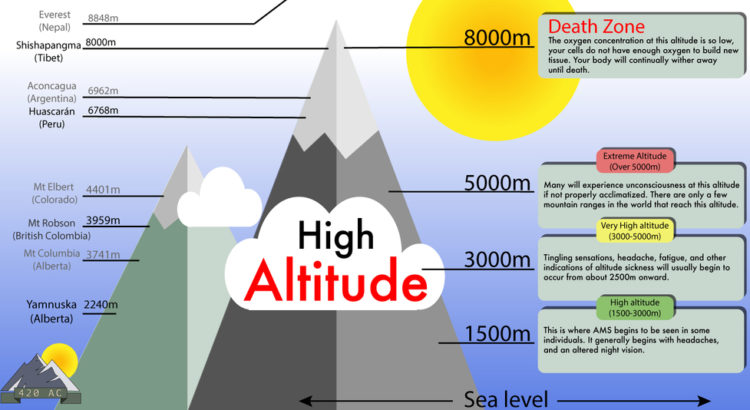
Air gets thinner as you move on higher altitude trekking in Nepal. You body cannot access enough oxygen at that level which causes problem in breathing. This weakens you gradually, which is called Altitude Sickness. Low air pressure, high exposure of sun, cold climate, thin and dry air attacks people ascending higher altitude. Generally, people mistakes altitude sickness with flu, hangover, dehydration and tiredness. There are 3 types Altitude Sickness- acute (mild) or mountain sickness (AMS), high-altitude pulmonary edema (HAPE) and high altitude cerebral edema.
Generally, Altitude sickness starts from the height of 2500m. When you start driving or trekking uphill quickly, your body does not have enough time to acclimatize well and this causes Altitude sickness. Your body cannot adopt the cold and thin air of higher level quickly as your body is used to in inhaling enough oxygen required for your body. The person who cannot adopt and adjust in thin air quickly becomes the victim of Altitude sickness. It is very sensitive and frequently happening problem among trekkers. Many trekkers have lost their life during trekking to Himalaya because of ignorance of Altitude sickness. Basically, trekkers who are willing to do Everest Base Camp trek, Annapurna Base Camp trek, and Manaslu Tsum Valley trekking, should highly take the basis of Altitude in consideration. High- altitude pulmonary edema (HAPE) is critical and life threatening sickness caused from non- cardiogenic pulmonary edema occurs from the quick and unhealthy drive or trek to the High altitude of 2500 m (8,200 ft) High altitude cerebral edema is a life threatening form of brain swelling with fluid because of nausea joining other worse symptoms. The unhealthy ascent to the area of thin air causes nausea, which in worse condition results cerebral edema.
The altitude sickness has some basic symptoms.
If these symptoms go worse, the person soon loses the sense of touching, hearing and visibility. If this goes more critical the person may die shortly.
Your body needs to adopt the temperature and the thin air of higher altitude to get rid of Altitude Sickness. Some of essential tips to get rid of altitude sickness include:
The victim should descent quickly until he gets enough supply of oxygen and feels well. Wait until 24 hours in the case of minor sickness and even if the condition doesn’t go right descent to lower level and get the medical treatments as soon as possible. You can also acclimatize and prepare your body well before your start your journey. Ascent uphill to about 8000 ft and try adjusting there but book your hotel at lower level. Try this couple of time before journey, this results your body to adjust in decreased oxygen. You can get a couple of acclimatizing day during your trek to Mt Everest Base camp, Annapurna Circuit Trek and other Himalaya Trek to make your body adopt the existing environment.
Don’t forget to carry medical kit before embarking to any kinds of Trek. Use acetaminophen or ibuprofen for headache. It is easily available in local medical clinics and the price is just a few cents. Hydride enough amount of liquid to the victim. This gives you supplements of energy and helps to cope the problems weakness, dizziness and vomiting. Keep person warm, so that his body can access the enough heat and feels strong.
Nepal government has formulated many plans regarding the optimum solutions of tourist health issue. For ex- You can visit many health service providers and make a whole body check up before you embark for Everest Base Camp Journey. These facilities are also available in classic Annapurna Circuit Trek and other adventurous Himalaya Trek. Visit health seminar conducted in different trekking rotes. NOTE- Avoid drinking alcohol during your trek to Himalaya or in other form of trekking


