

Main Navigation

Manaslu Circuit Trek is getting popularity day by day. It is taken as an alternative route of Annapurna Circuit trekking in Nepal. The wilderness destination is not easy to complete The Manaslu Himal in mid-western Nepal contains some of the most beautiful and dramatic scenery in the Himalaya. The south is peopled by Hindu Newars and Buddhist Gurungs. The north is home to an older Gurung and Tibetan communities; speaking independent Tibetan dialects. Engaging in this rich cultural mix is one of the highlights of this trek.

The trail, from village to village, starts at low Soti Khola (700m/2 300ft) and follows the course of the powerful Budhi Gandaki that forms high in the range (eight days away). It is supplemented by countless streams; including the large Siyar Khola from the eastern Tsum Valley. The river and incoming water courses have cut deeply into the landscape, creating a topography that demands much initial up and down walking on good, sometimes exposed, trails. The effort is offset by countless waterfalls, lush vegetation and ever changing views. (Manaslu is only ‘revealed’ on the eighth day!) On the fifth day the gorge narrows and the trail climbs high above the river (to Ekle Bhatti – one-house village; and exquisite views). It then gently descends to a fork in the trail: right to the Tsum Valley, left to Manaslu. (If you can find the time, include a week in the Tsum Valley. This beautiful, unique, region has only been open for trekking since 2008. It offers an especial glimpse of a people, the Tsumbas, who have lived there, trading with Tibet for over 800 years. Explore impressive square chortens, monasteries, nunneries and friendly clustered stone-housed communities. Ancient farming methods are still used in stone walled fields. Rustic and newer lodges offer a warm welcome and good food.)

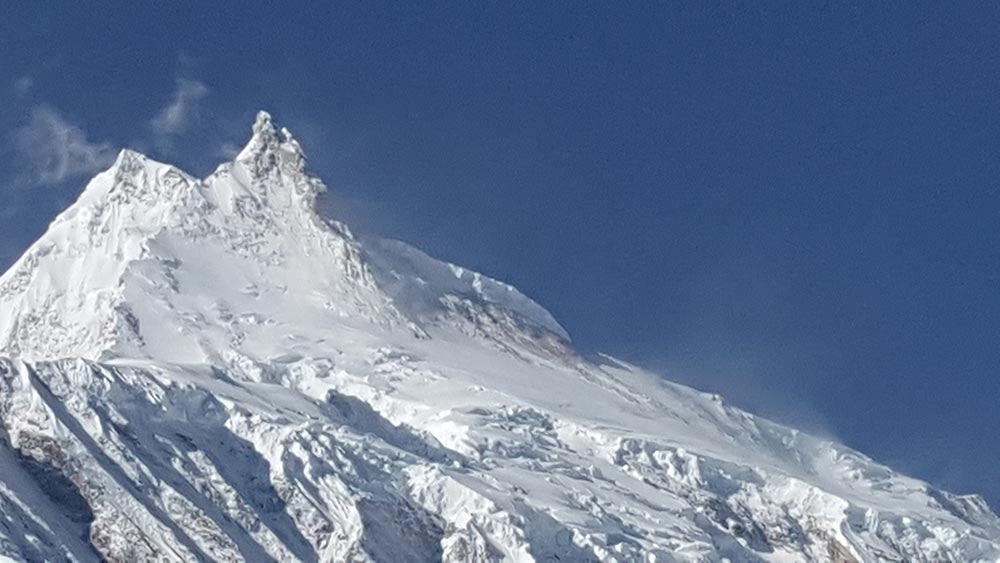
The Manaslu trail follows the Budhi Gandaki NW to its source and as it rises the scenery gradually becomes more dramatic: snow peaks appear north and south of the trail and slowly get closer. The first views of Manaslu, floating above Lho, are magical. Visit the large monastery. An acclimatization day is spent at Samagaon. Climb to Manaslu’s Base camp above the village or tackle the lower walk to the Pungyen Nunnery on the glacier at the foot of Manaslu (hidden from Sama). Lodges are comfortable and many new ones are being built all along the trail. Next is a lovely walk along the reduced river as it rises above the tree-line to Samdo; the last village before Gho three days away! Follow yak trails above the village for panoramic views back down the valley and westwards to the Larkya La. The next day, walk gently to the high camp at Dharamsala and rest. Then tackle the 5 160m Larkya La. This is not a difficult pass (unless snowbound) and rises gradually to the first of two sets of summit flags along the glacier. The second reveals an exquisite and unexpected snowbound valley with three glaciers. Drop steeply for 1 500m on a tricky loose trail to the valley below. Walk to great lodges at the summer grazing Kharka of Bimthang. You are now in the Annapurna conservancy. Cross a glacier and plunge into magnificent deep forest for the walk down to warmer Gho. Your route then drops to Dharapani on the Annapurna Circuit route and on to Tal. Next day, drive out to Kathmandu or Pokhara.
 This trek is more demanding than the Annapurna circuit so initial fitness and stamina is essential for full enjoyment. The low altitude start helps with acclimatization as 3 000m is only reached after five (Tsum) or six (Manaslu) days: adding ~ 500m/day thereafter. The chances of altitude problems are thus diminished. April – May treks can be very hot in the lowlands and mountain views hazy. Busier September – November treks are cooler and the post-monsoon air clear for great photography; night temperatures plummet at altitude. Please note that numerous sections of trail are exposed to steep drops next to the path in both regions. If you have a fear of heights then this trek may not be for you. (This is not a problem on the Annapurna trails.)